If your store carries hundreds or thousands of products, your search bar is either your best salesperson or your biggest hole. Most shoppers won’t scroll through all the results pages. They’ll type something they need, get or not get the relevant results. You will be sure it is a traffic problem. But that’s a problem with your site’s search. AI-powered search changes the equation. It understands what shoppers mean and what they search for, not just what they type.
This guide breaks down the best AI tools for eCommerce search available today, explains the difference between AI search and basic search, and helps you figure out which solution fits your stack and growth revenue.
What is AI Search for eCommerce?
Traditional site search works like a keyword index. A shopper types “moisturizer for oily skin,” and the engine looks for products containing those exact words. Of course, it overlooks a synonym, forgets to tag a product, or handles a typo, and the shopper ends up empty-handed even if the store has what they need.
AI-powered product search is a different approach. It uses a combination of all techniques:
- Semantic search for Commerce interprets the intent behind a query rather than hunting for literal matches.
- In natural language search (NLP), shoppers describe what they want in the same way they would ask a friend or shop assistant.
- Personalized search adapts results based on browsing history, purchase behavior, and even real-time session signals.
- Predictive search auto-completes queries in ways that lead to purchases, not just completions.
- Vector search is the underlying engine for much of this. It maps products and queries into a shared mathematical space. So it makes it possible to find relevance even when words don’t match.
Together, these capabilities make AI search especially powerful for complex, extended product categories: cosmetics with hundreds of ingredient variations, dietary supplements, technical hardware, apparel with nuanced sizing and fit attributes, or any catalog where a shopper’s real need is difficult to express in 2 or 3 keywords.
Key Features to Look for in AI Search Tools in 2026
Not every “AI search” tool is equally capable. Before evaluating specific platforms, it helps to know what actually matters:
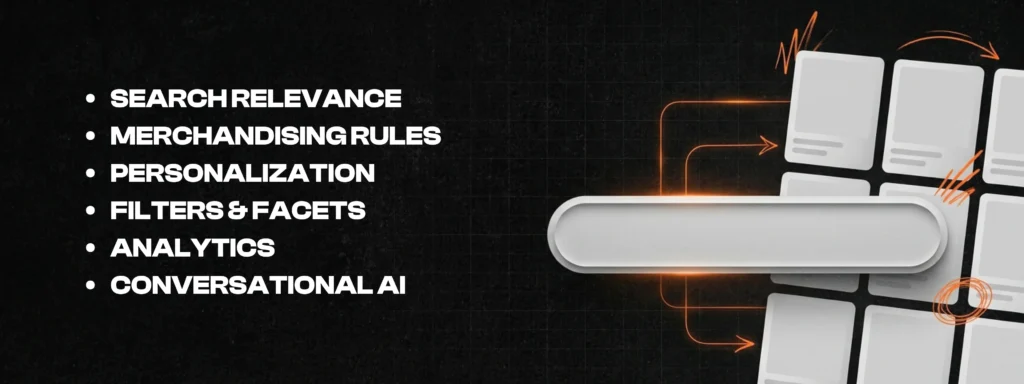
Search relevance tuning – the ability to surface the most appropriate products, not just any products that technically match.
Merchandising rules – manual overrides that let your team promote seasonal items, exclude out-of-stock products, or pin specific results to the top of certain queries.
Search personalization – query results that adapt to individual user behavior over time, increasing conversion without any extra work from the shopper.
Faceted and filtered search – AI-assisted filtering that helps narrow results dynamically, especially useful for large catalogs.
Analytics and query reporting – visibility into what shoppers are searching for, what they’re not finding, and where the gaps are in your catalog or tagging.
Chatbot and conversational commerce integration – and this one is often overlooked. The best implementations bring the same intelligence into a conversational AI shopping assistant for eCommerce, letting users find products through dialogue the same way they would through a search field.
Best AI Tools for eCommerce Search: Our Top List
AI increasingly shapes product discovery in e-commerce. But not all tools solve the same problem. Some focus on making traditional keyword search faster and more relevant. In contrast, others approach discovery through conversational interfaces, letting shoppers describe what they need rather than searching for a specific product name. The tools below showcase a variety of these methods, from high-performance search APIs to AI assistants and support platforms that have grown into product guidance.
1. Algolia
It is best for large catalogs, developer teams, and high-performance search. Algolia is one of the most widely deployed eCommerce search engine software solutions in the market. It offers a hosted search API with AI-powered ranking, NLP, and extensive personalization capabilities, built on its blazing-fast infrastructure.
Algolia stands out with its combination of speed and configurability. You can define your own ranking formula, create synonyms and redirects, and layer machine learning models on top of manual merchandising rules. Algolia’s AI Search product uses vector search to understand semantic intent, not just keyword frequency.
It also provides strong analytics out of the Box, letting teams see exactly which queries convert and which result in zero-result dead ends. It’s a top-tier choice for enterprise eCommerce teams that want to control and have intelligence.
Key capabilities of Algolia:
- semantic search
- personalized search eCommerce
- vector search
- A/B testing
- merchandising rules
- analytics
- multi-language support
2. Rep AI
It is best for conversational Commerce, AI shopping assistants, and Shopify stores of different sizes. Rep AI approaches eCommerce search from the conversational angle. Rep AI uses an AI chatbot to proactively engage shoppers. It assists users when they appear stuck, answering their questions and directing them to appropriate products.
This matters because a growing share of product discovery occurs entirely outside the search bar. When shoppers ask questions and compare options, they describe problems rather than product names. Rep AI’s assistant handles all of this.
Rep AI’s conversational approach is particularly effective for categories like skincare, supplements, and technical equipment, where shoppers often don’t know the right product name, only their problem. It also perfectly integrates with Shopify catalogs. This simplifies deployment for Shopify-based stores.
Key capabilities of Rep AI:
- AI chatbot for product search
- proactive engagement
- conversational Commerce
- product recommendations
- Shopify integration

3. Gorgias
It is best for customer support teams that need to bridge service and discovery. Gorgias is known as a customer support helpdesk platform. But its AI capabilities have increasingly moved into product discovery. Gorgias uses AI to handle common support interactions and can surface product recommendations within support conversations. Gorgias is in the middle of support and intelligent product guidance.
It is mostly suitable for eCommerce brands where customer questions often turn into purchase decisions: “Can I use this serum with retinol?” Which protein powder is best for weight mass?” It has deep integrations with Shopify and BigCommerce.
Key capabilities of Gorgias:
- AI-powered support automation
- product recommendations in chat
- order management integration
- Shopify/BigCommerce integrations

4. Searchanise
It is best for Shopify and WooCommerce stores looking for an affordable, full-featured option. Searchanise is a site search tool for eCommerce that combines smart autocomplete, AI-powered relevance, filtering, and merchandising features. It’s available across major platforms like Shopify, WooCommerce, and BigCommerce. Plus, it doesn’t require developer resources to get running.
Searchanise is not as flexible or scalable as Algolia. But it is a perfect option for stores in the growth phase that want to add predictive search eCommerce, customizable filters, and basic personalization without a heavy lift.
Key capabilities of Searchanise:
- Smart autocomplete
- predictive search
- product recommendations
- merchandising rules
- platform integrations
5. Luigi’s Box
It is best for mid-market eCommerce and analytics-driven teams. Luigi’s Box is not so popular, but it is a highly capable AI product discovery tool with strong semantic search, personalization, and an analytics suite built around search behavior. It’s typically spread among European retailers and supports a wide range of product verticals.
The platform includes search, recommendations, product listings, and analytics in a single package. Its AI models adapt to user behavior over time, improving relevance without manual retraining. If your teams want to understand the full picture of how shoppers interact with their catalog, use Luigi’s Box. It offers unusually detailed search intelligence.
Key capabilities of Luigi’s Box:
- Semantic search
- personalization
- product recommendations
- behavioral analytics
- A/B testing

How to Choose the Right AI Search Tool: 5 Questions
- How large is your catalog? How many attributes does each product have? Larger, more complex catalogs benefit more from semantic and vector search capabilities.
- Do your customers typically search by product name, or do they search by problem, or ingredient? The latter demands stronger NLP and semantic understanding.
- What eCommerce platform are you on? Some tools are optimized for Shopify, while others are platform-agnostic but require more integration work.
- Do you need conversational search? You should consider an AI chatbot for product searches if your product categories involve consultative buying decisions rather than just a traditional search bar.
- Are you collecting behavioral data? Some tools require a data foundation to deliver their full value.
AI Search vs. AI Chatbots: Do You Need Both?
Is an AI search bar and an AI chatbot for product search the same thing? Not quite, but the line between the two is blurring.
AI Search
AI search lives in the search bar. As usual, shoppers type a query, the engine interprets it semantically, and gives the results. It’s fast, familiar, and works well for shoppers who already know what they search for.
AI Chatbots
AI chatbots for product discovery work differently. Instead of typing a query, a shopper describes their need with a sentence or two. The bot asks follow-up questions, narrows options, and gives recommendations. This is closer to how people shop in a physical store with a shop assistant.

Both options have distinct strengths, but they serve different shopper intents. Of course, the most successful eCommerce search strategies deploy AI for query-based behavior, and a conversational AI shopping assistant for exploratory or complex decisions.
How IT Delight Helps: AI Integration Advisory Services
There is a gap between choosing the right tool and its implementation. And this is where most effort, time, and money are lost. We offer AI Integration Advisory Services to help you avoid this phase.
Pay attention, we do not tell you which platform has the best marketing page. We work through what your catalog actually looks like, how your shoppers actually behave, and what your team can realistically maintain once the integration is live. Simply put, we are auditing your product data before a tool is configured, not after. In addition, our team stays involved after launch as the real optimization work begins. Want to implement AI search the right way? Talk to our team.
To Sum Up
eCommerce search engine software understands intent, adapts to behavior, and surfaces the right product even when shoppers can’t articulate exactly what they’re looking for. This serves as the essential minimum for large catalogs and complex product categories.
The best AI tools for eCommerce search aren’t just those that someone says. You should analyze what fits best for your business case. The right tool depends on your catalog size, your platform, your customers’ buying behavior, and how much of your discovery experience lives in a chat interface versus a search bar. Typically, the solution involves combining AI-powered search with an AI shopping assistant for eCommerce, working together across the entire shopper journey.
If you’re ready to move beyond guesswork and implement AI search the right way, book a call with IT Delight to choose the best AI search stack. We’ll help you choose, build the right integration, and measure the results that matter before you run into its pitfalls.