


Odoo for eCommerce becomes a strategic advantage when an online business starts to scale and operational complexity grows faster than revenue. Spreadsheets, disconnected tools, and manual workflows may work at an early stage, but over time they lead to order inconsistencies, inventory inaccuracies, delayed fulfillment, and fragmented customer data — slowing growth, increasing costs, and limiting visibility.
As a flexible, all-in-one ERP platform, Odoo centralizes and automates core eCommerce processes such as sales, inventory management, accounting, CRM, and logistics, helping online retailers eliminate data silos and build a scalable foundation for long-term growth.
Understanding Odoo: A Modular ERP Platform for eCommerce
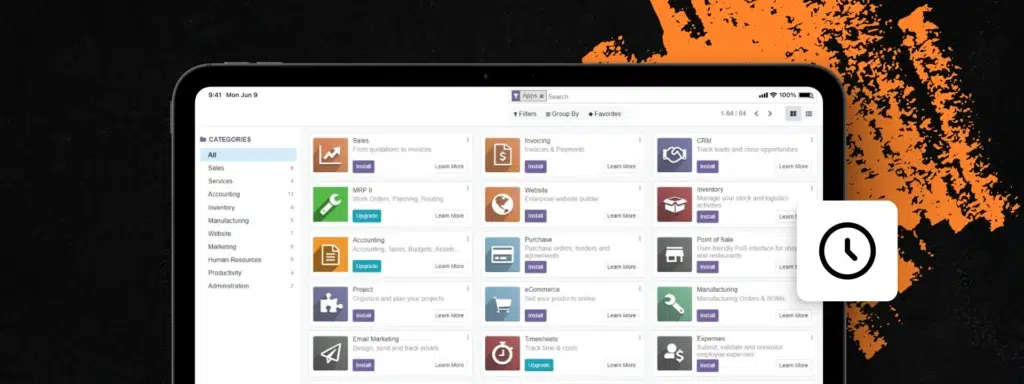
Odoo is an open-source ERP system built on a modular architecture, allowing businesses to implement only the functionality they need — and expand as requirements evolve. Instead of investing in a rigid, oversized ERP from day one, companies can start with essential modules such as Sales, Inventory, and Accounting, and later add Manufacturing, Marketing Automation, or Helpdesk.

All Odoo modules operate on a shared database, creating a single source of truth across the organization. For eCommerce businesses, this means that every online order automatically updates stock levels, triggers accounting entries, informs fulfillment teams, and enriches customer profiles. This real-time data synchronization reduces manual work, minimizes errors, and ensures consistent information across all departments, helping streamline operations and support growth.
Who Should Use Odoo for eCommerce?
Based on IT Delight’s implementation experience, Odoo delivers the highest value for the following business models:
Growing eCommerce Brands Moving Beyond Spreadsheets
When order volumes and product catalogs expand, spreadsheet-based operations become unreliable and time-consuming. Odoo provides structured workflows, automation, and real-time insights without sacrificing flexibility.

Multi-Channel Retailers
Businesses selling via multiple channels — online stores, marketplaces, and offline locations — benefit from Odoo’s centralized inventory and order management. Product data, pricing, and stock levels stay synchronized across all sales touchpoints.
B2B eCommerce Companies
Odoo is especially strong for B2B eCommerce, supporting tiered pricing, customer-specific catalogs, quotation workflows, contract-based billing, and recurring invoicing — features often missing in standard eCommerce platforms.
Companies Focused on Data Transparency
For businesses that rely on analytics and forecasting, Odoo offers advanced reporting and dashboards that provide real-time visibility into sales performance, inventory turnover, and financial health.
Build a Scalable eCommerce Operations Strategy
We help growing online businesses optimize processes, systems, and technology for long-term growth.
Integration vs. Customization: Strategic Implementation Choices
While Odoo covers a wide range of use cases out of the box, the implementation strategy is critical:

Ready-Made Integrations
Odoo connectors are ideal when integrating with popular marketplaces, payment providers, shipping services, or accounting tools. They reduce implementation time and cost while maintaining system stability.
Custom Odoo Development
Custom development is recommended for businesses with unique operational workflows or industry-specific requirements. Although it requires a higher initial investment, it ensures that Odoo fully supports competitive business processes.
Hybrid Approach
Most growing eCommerce companies choose a hybrid model — combining standard Odoo modules, trusted third-party integrations, and targeted customizations. This approach balances cost, speed, and flexibility.
Key Benefits of Using Odoo for eCommerce
Odoo provides eCommerce businesses with a centralized ERP platform that streamlines daily operations, improves data accuracy, and supports long-term scalability. By replacing disconnected tools with a single integrated system, Odoo helps online retailers operate more efficiently, gain complete visibility into their business, and reduce operational costs as they grow.
- Operational efficiency through automation – Odoo automates order processing, inventory updates, invoicing, and reporting, reducing manual work, eliminating duplicate data entry, and helping eCommerce teams save up to 30–50% of operational time.
- Real-time visibility across the entire business – With centralized dashboards and unified data, businesses gain instant access to key metrics such as stock availability, sales performance, margins, and customer behavior, enabling faster and better-informed decisions.
- Scalable ERP architecture for growing eCommerce businesses – Odoo’s modular structure allows companies to start with core functionality and gradually add new modules as the business grows, without replatforming or disrupting existing operations.
- Lower total cost of ownership compared to traditional ERPs – By combining multiple business functions into one platform and reducing the need for third-party integrations, Odoo delivers enterprise-level capabilities at a significantly lower overall cost.
Odoo Implementation: What to Consider
A successful Odoo implementation starts with a clear understanding of your existing workflows, operational bottlenecks, and business goals. This discovery phase defines the project scope, priorities, and technical requirements, ensuring that Odoo supports real business needs rather than adding unnecessary complexity. Equally important are data migration, system configuration, and team onboarding — while Odoo is intuitive, structured change management significantly accelerates adoption and ROI. Long-term success also depends on regular updates, security maintenance, and continuous system optimization as the business evolves.
At IT Delight, we approach Odoo implementation as a strategic business transformation, not just a technical setup. We design scalable, phased rollouts aligned with business goals and continue supporting clients after launch to ensure Odoo grows together with their eCommerce operations.
Conclusion
Odoo helps eCommerce businesses replace disconnected tools with one scalable system, automate daily operations, and gain real-time visibility as they grow. For online stores facing complexity or scaling challenges, Odoo offers a flexible and cost-effective ERP solution that supports long-term efficiency and more thoughtful decision-making — especially when implemented with the right partner.

