


OpenAI is accelerating a fundamental shift in how people discover and purchase products online, moving commerce from websites into conversational, AI-driven environments. Instead of clicking through pages or completing multi-step checkout flows, users can now ask ChatGPT for advice, explore product options, and complete a purchase instantly within the same interface. This marks a turning point where AI becomes not just a recommendation engine, but an active participant in the transaction itself.
This transformation is no longer theoretical. Two major announcements – OpenAI’s launch of Instant Checkout with Stripe and its new partnership with PayPal – demonstrate the rapid evolution of the ecosystem. These collaborations combine intelligent product discovery with trusted, frictionless payment experiences, laying the groundwork for a future where AI agents handle both guidance and Checkout.
The Stripe + OpenAI Launch: Inside Instant Checkout & Agentic Commerce Protocol
On September 29, 2025, Stripe and OpenAI unveiled a new shopping experience inside ChatGPT called Instant Checkout. It allows users to discover products, receive AI-generated recommendations, and complete purchases directly within the chat interface. Instead of redirecting users to external storefronts, the entire journey happens in one place — from product suggestion to payment confirmation.
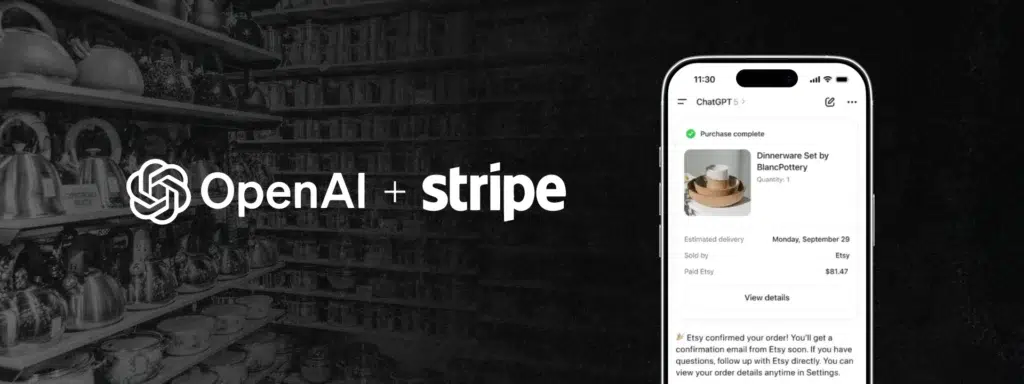
At launch, this functionality is available to ChatGPT users in the United States, who can already purchase products from Etsy sellers without leaving the conversation. Support for Shopify merchants is expected to follow soon, significantly expanding the range of brands and products accessible through in-chat purchasing.
Instant Checkout relies on a secure, tokenized payment flow powered by Stripe, enabling users to tap “Buy” and finalize transactions seamlessly. Underpinning this experience is the Agentic Commerce Protocol, an open standard jointly developed by Stripe and OpenAI. Designed specifically for the era of agentic commerce, it provides businesses with a standardized way for AI agents to securely access product data, communicate with merchants, and initiate payments on behalf of users.
To support this model, Stripe also introduced Shared Payment Tokens, which allow users to approve transactions without exposing sensitive card information. This approach enables merchants to participate even if they rely on alternative payment providers, as long as those providers support the protocol.
For merchants, this shift unlocks an entirely new sales channel where AI-driven discovery is directly connected to checkout inside the conversation itself. Stripe, in turn, is positioning itself as the underlying payments infrastructure for AI commerce. At the same time, ChatGPT evolves from a conversational assistant into a fully integrated shopping and transaction environment that shortens and simplifies the path from intent to purchase.
The PayPal + OpenAI Partnership
The announced partnership between PayPal and OpenAI outlines a vision for bringing trusted, wallet-based payments into the era of agentic commerce. Instead of traditional online shopping flows with multiple pages and checkout steps, the planned integration would allow users to complete purchases directly inside ChatGPT using their existing PayPal accounts. While the functionality is not yet live, it clearly signals PayPal’s ambition to become a key financial layer for AI-driven transactions.

A major strength of this approach is the trust and familiarity millions of users already associate with PayPal. By enabling payments through PayPal wallets, linked bank accounts, stored cards, or financing options, AI-based purchasing is designed to feel both secure and intuitive. Future development phases are also expected to extend PayPal’s core protections – such as dispute resolution, refunds, and transaction monitoring – into the agentic commerce environment, ensuring the same level of buyer protection as in traditional eCommerce.
For merchants, PayPal’s global network offers immediate scale, enabling AI-powered checkout across regions with minimal additional setup. Although the timeline and final feature set are still evolving, the direction is clear. By combining PayPal’s global reach with OpenAI’s conversational intelligence, the partnership is laying the foundation for a new commerce model in which AI agents guide discovery, decision-making, and, eventually, payment authorization.
Stripe vs PayPal: Different Strategies, Same Vision
Stripe and PayPal are both working toward the same goal: turning AI into a real commerce channel, not just a recommendation layer. They agree that buying will increasingly take place within conversations, with AI agents guiding users from discovery to purchase. Where they differ is in how they enable that future.
Stripe approaches agentic commerce from an infrastructure and technology standpoint. Its focus is on building the underlying payment rails that enable AI-driven transactions to occur instantly and invisibly within chat interfaces. By developing open standards, tokenized payments, and deep-integration tools, Stripe is positioning itself as a developer-first platform for merchants who want to fully embed AI into their commerce stack.
PayPal takes a more consumer-facing path. It relies on the familiarity and trust users already have in its wallet-based payments, along with its massive global merchant network. Instead of asking businesses or customers to adapt to new systems, PayPal reduces friction by bringing AI commerce into an interface people already know, while also extending protections like dispute resolution and refunds.
Despite these differences, their long-term vision is closely aligned. Both Stripe and PayPal see a future where AI agents recommend products, users approve purchases directly in conversation, and commerce shifts away from traditional websites toward intelligent, interactive experiences. In different ways, they are building the foundation for the same destination: AI as a primary channel for buying and selling.
Implications for eCommerce Merchants & How Businesses Can Prepare
The shift toward instant, AI-led purchasing fundamentally changes how merchants are discovered and how sales happen. When transactions move into conversational interfaces like ChatGPT, the traditional storefront is no longer the primary place where buying decisions are made. Instead, AI agents evaluate products, compare options, and guide users toward a purchase based on structured data rather than visual design or manual navigation.

In this model, a merchant’s website becomes a trusted data source for AI systems. Product information, availability, pricing, and policies must be easy for AI to read, interpret, and act on. Businesses that rely on poorly structured catalogs or outdated technical setups risk being overlooked entirely as AI-driven discovery becomes a dominant channel.
Product Data Quality & Structure
AI agents rely on clean, well-structured product data to understand what a merchant is selling. Clear titles, consistent attributes, accurate variants, proper categorization, and up-to-date availability are essential for products to be correctly recognized and recommended in conversational shopping flows.
Technical Foundation & Performance
A stable technical setup ensures that AI agents can access product data reliably and in real time. This includes modern platform versions, clean APIs, scalable architecture, and integrations that align with emerging standards such as the Agentic Commerce Protocol.
Payment & Checkout Readiness
As AI-led checkout becomes possible through providers like Stripe and PayPal, merchants must be ready to support flexible, tokenized, and AI-compatible payment flows. Payment systems should seamlessly integrate with in-chat purchasing without disrupting existing checkout processes.
Preparing for agentic commerce requires a holistic approach that combines data, technology, and payments. By improving product data quality, strengthening technical foundations, and modernizing payment integrations early, merchants position themselves to remain visible, competitive, and ready as AI becomes a core driver of eCommerce growth.
Prepare Your eCommerce Business for Agentic Commerce!
Discuss with IT Delight how AI will change discovery, checkout, and growth.
What This Means for the Future of Shopping & AI-Driven Commerce
The rise of agent-led purchasing signals a clear move away from traditional browsing. As ChatGPT becomes capable of guiding decisions and completing transactions, shopping transforms into a seamless, conversational experience that can make consumers feel more satisfied and confident in their choices.

For consumers, this means faster, more intuitive purchases: they describe what they need, receive relevant options, and complete checkout in a single interaction. For the industry, it signals AI’s rise as a primary interface for product discovery, with websites evolving into structured data sources rather than decision-making hubs, guiding future shopping trends.
Brands that adapt early – by optimizing product data, ensuring payment compatibility, and preparing for agentic interactions – will gain a clear advantage as AI-driven commerce scales.
Conclusion
The moves by Stripe and PayPal demonstrate that AI commerce is entering a strategic phase, with shopping increasingly shifting into conversational interfaces where discovery, decision-making, and checkout occur seamlessly in one environment.
Businesses that prepare early by improving data quality, strengthening technical foundations, and enabling AI-compatible payments will be best positioned to stay visible, competitive, and relevant as agentic commerce becomes mainstream.

